

Although Article 325(4) of the Companies Act empowers the Court to restore a company struck-off as defunct to the register, the granting of such restoration order, is by no means automatic. Restoration of a defunct company is a discretionary remedy, requiring the Court to be satisfied not only that the applicant is a shareholder, creditor or has a legitimate interest in the reinstatement of the company and that the statutory five-year period has not lapsed, but also that it considers it “proper” to do so.
Equally important is the Court’s assessment of whether the applicant is genuinely committed to regularising the company’s affairs and restoring it to good standing with the Registrar of Companies (the “Registrar”). A recent example of the Court’s approach can be found in the judgment in the names Jonathan Vella vs Ir-Reġistratur tal-Kumpaniji (Case number 27/2023). In that case, the applicant initially sought the restoration of three companies of which he was a director. During the proceedings, however, he abandoned his request in respect of two of the entities and pursued restoration only in relation to one company, claiming a legitimate interest in doing so by virtue of his role as an officer of such company.
The decision is significant because it highlights that restoration of a struck-off defunct company is not an automatic consequence of filing an application within the prescribed five-year period. In this case, the Court placed considerable emphasis on the applicant’s conduct during the proceedings. Despite being granted multiple adjournments over the course of approximately three years to afford him opportunities to regularise the company’s position to the satisfaction of the Court and the Registrar as counter-party, the applicant failed to submit the outstanding statutory filings or settle the amounts due in penalties to the Registrar. The judgment underscores that the Court’s discretion under Article 325(4) extends beyond a purely procedural assessment and that an applicant seeking restoration must demonstrate a genuine willingness to achieve compliance. Where repeated opportunities to rectify long-standing defaults are disregarded, the Court may decline to order restoration notwithstanding the existence of an interest in the company’s reinstatement and satisfaction of all the other statutory conditions required for an application of this kind to be successful.
Whilst the application may initially have been brought with good intentions and a commitment to regularise the company’s position, the applicant’s continued failure to take the necessary steps to remedy the company’s defaults undermined the credibility of those intentions. In such circumstances, the Court considered itself unable to disregard those shortcomings and was required to strike an appropriate balance between the interests of the applicant, the Registrar and the wider public interest in ensuring compliance with statutory obligations.
Ultimately, the decision sends a clear message: the restoration remedy exists to assist those who are genuinely committed to bringing a company back into compliance, not to revive persistently non-compliant ones. Filing an application within the statutory time limit is only part of the equation. An applicant must also demonstrate a genuine willingness to remedy the defaults that led to the company’s strike-off. Where repeated opportunities to regularise its position are ignored, the Court will not hesitate to refuse restoration on this basis as it did in this particular case.
Disclaimer: The information provided in this article does not, and is not intended to, constitute legal advice. Fenech & Fenech Advocates was not involved in this case. All information, content, and materials available are for general informational purposes only. This article may not constitute the most up-to-date legal or other information and you are advised to seek updated advice.
OUTLINE
Related Insights


Legal 500 Enforcement of Judgments in Civil & Commercial Matters Comparative Guide 2026: Malta
View


Episode 23 | Recent Developments in the local Foreign Direct Investment (FDI) landscape
View


Malta Chapter for White & Case’s 2025 Foreign Direct Investment Reviews Guide
View


Challenging Enforcement of Cross-Border Tax Claims under Council Directive 2010/24/EU
View

The Significance of the Register of Members in Corporate Practice: Overlooked yet Essential
View


Bill 96 – Share Buy-Backs and Reduction of Share Capital: The Proposed Amendments
View





Time to repeal the Suspension of Filing for Dissolution and Winding up Regulations
View



Redom Updated – Cross-Border Conversion of Limited Liability Companies (Part 2 of 3)
View



Malta’s foreign direct investment (FDI) regime and its implications in practice
View

The Corporate Sustainability Reporting Directive (CSRD) finally comes into force
View


The meetings of a Maltese company: How critical is the company secretary’s role?
View
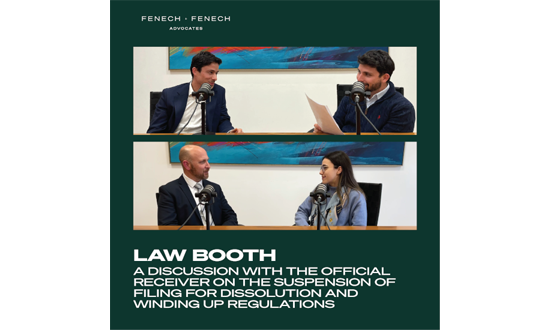
Law Booth – Episode 3 – A discussion with the official receiver on the suspension of filing for dissolution and winding up regulations.
View


Farmers, fishermen and primary food suppliers to benefit from protection against unfair trade practices
View

Is it time to ‘wind up’ the suspension of filing for dissolution and winding up regulations?
View


Re-Dom Alert: Continuation of a Maltese Company outside Malta – Part 2 of 2
View


EU merger control toughens up on Pharma and Digital deals with the EC’s new Article 22 Guidance on referrals to the EC
View


RECAP: Amendments to the Companies Act (Register of Beneficial Owners) Regulations
View


The publication of L.N. 373 of 2020 temporarily relaxing insolvency legislation
View

The Role and Responsibilities of Directors (Part 1): A Maltese Perspective – Terralex
View


The Company Recovery Procedure as a viable tool after the Covid-19 crisis
View
EU Covid-19 State Aid measures and planned amendments to Airport Slots Regulations
View

Technical Specifications in Public Procurement – Public Contracts Review Board confirms the ‘or equivalent’ rule
View


The new HCCH Judgments Convention – the next step in cross-border recognition and enforcement of judgments?
View
